

Yesterday, I got a call about a partition door falling down in a hotel banquet hall.
The owner was stressed. I asked him, "Do you know what track system was installed?" or "How did they weld the steel structure?"
He just shook his head. "I don't know. The guy who built it didn't leave any papers."
I hear this a lot. And honestly, it's the most dangerous answer I can get.
I've been handling movable partition maintenance and repair for 27 years. Even without seeing the drawings, I can tell you exactly why that door fell. It's usually one of three things.
Here is the plain truth about what happens inside your ceiling.
3 Hidden Reasons Why Partition Tracks Fail
1. The Track Was Too Soft (The "Soda Can" Effect)
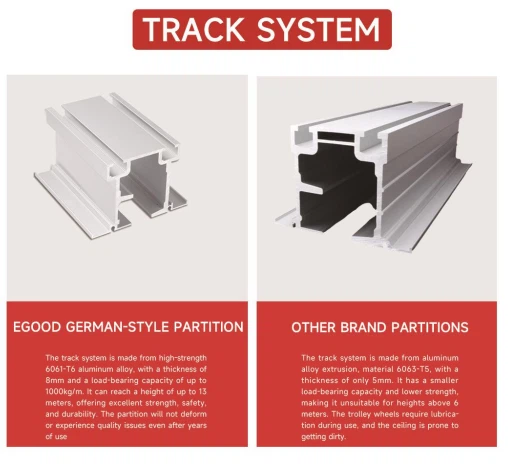
To most people, an aluminum track is just a metal rail. But in our world, there are two kinds of aluminum: 6063-T5 and 6063-T6.
- The Cheap Stuff (T5): It's softer. It's cheaper. Many factories use it to save money. When you hang a 500kg door on it, it holds... for a while. But over a year or two, the weight pulls the track open. It stretches like a soda can tab until-snap-the rollers slip out.
- The Real Stuff (T6): This is what we use at Egood for our heavy-duty track systems. It's harder. It doesn't stretch. You can feel the difference just by tapping it with a coin. It rings like a bell, not a thud. That hardness is what keeps the door over your head, not on the floor.
2. The Wheels Were Plastic (The "Grocery Cart" Problem)
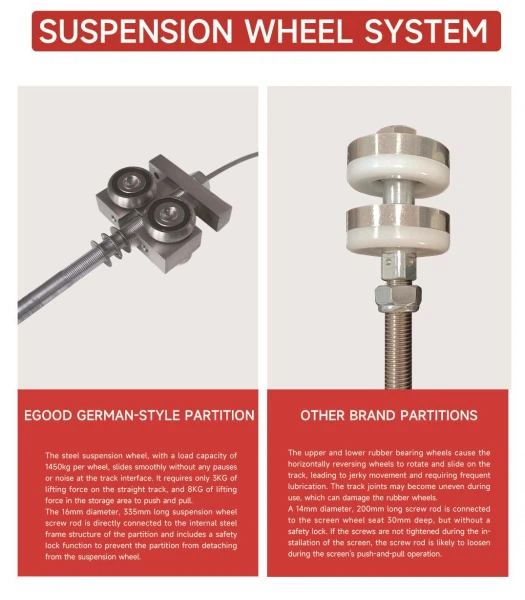
You know how a grocery cart wheel gets stuck and wobbles? That's what happens to cheap partition rollers.
- The Problem: To save a few dollars, some suppliers use generic nylon wheels with cheap steel bearings inside. They work fine when new. But after a year, the nylon cracks, and the steel rusts. One day, a waiter pushes the door a bit too hard, and the wheel just disintegrates.
- The Fix: We use a material called DuPont™ POM (it's a super-strong industrial plastic) and high-grade steel bearings. It's built to take a beating. It doesn't crack, and it doesn't get stuck.
3. The Welding Was Lazy (The "Hidden" Danger)
The most important part of a movable wall is the part you never see: the steel structure inside the ceiling.
What We Find: In many "low bid" jobs, I climb up the ladder and see the steel frame is barely held together. Just a few spot welds. No diagonal braces. It's shaky.
How We Do It: We calculate the weight before we even start. If the door is heavy, we weld the steel solid. Full welds. Extra bracing. It's not pretty, and nobody sees it, but it's the only way I can sleep at night knowing those doors are safe.
How to Diagnose Your Movable Wall Risks
If you are a hotel owner or a contractor, and your partitions are hard to push, making grinding noises, or hanging crooked-don't ignore it. These are signs of operable wall safety failure.
It doesn't matter if you lost the old paperwork. Call us.
I can send a guy over (or look at photos/video). We will:
- Check the track with a laser to see if it's bending.
- Look at the wheels to see if they are about to break.
- Peek in the ceiling to make sure the steel is solid.
We aren't here to sell you a fancy new system if you don't need one. We just want to make sure your doors stay up.
Safety isn't complicated. It's just using the right stuff.
Need a Safety Check?
Don't wait for a door to fall. Contact Egood Partition today for a free consultation or send us a photo of your track for a quick diagnosis.